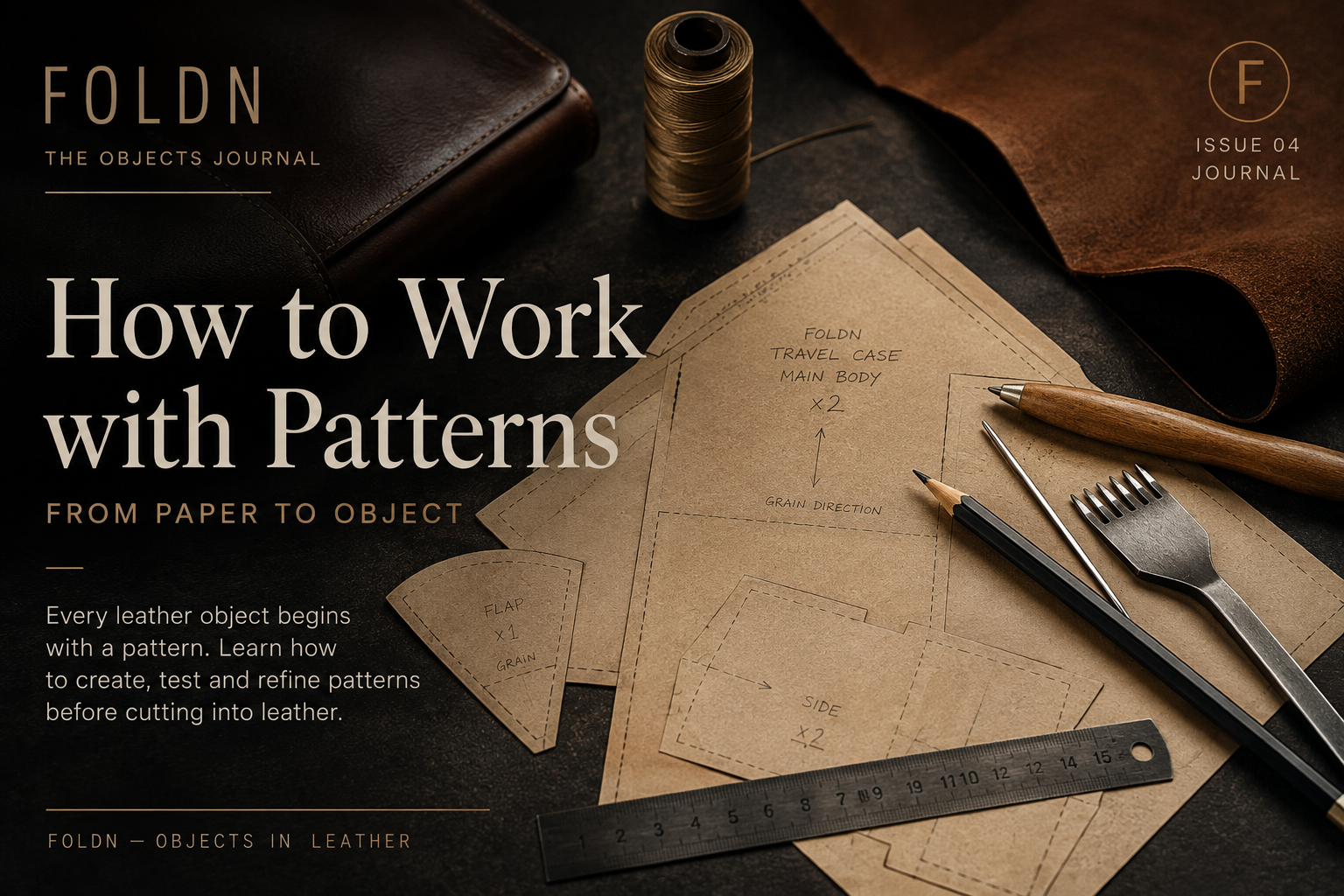
Before a leather object exists, there is usually a piece of paper.
A pattern may look insignificant. A few lines, some measurements, perhaps a curve or two. But those lines determine almost everything that happens later.
The shape of the object.
The proportions.
The position of the seams.
The amount of leather required.
And, eventually, whether the finished piece looks intentional or simply wrong.
Working with patterns is therefore one of the most important skills in leathercraft.
Start with the object, not the leather
A common mistake is to take a piece of leather and immediately start cutting.
It feels productive.
It is also an expensive way to discover that the proportions are wrong.
A better approach is to begin with the object itself.
What will it hold?
How will it open?
Where will it fold?
How much space should be inside?
Will it be carried in a bag, placed on a desk, or used while travelling?
The answers determine the pattern.
The pattern is not decoration. It is the physical plan of the object.
Paper is cheap. Leather is not.
The first version should almost never be made from leather.
Use ordinary paper, cardboard or another inexpensive material.
Cut it.
Fold it.
Join the pieces.
Put the intended objects inside.
Then look at it from every direction.
A pattern that looks perfect on a flat table can behave completely differently once it becomes three-dimensional.
A flap may be too short.
A fold may be in the wrong position.
An opening may be too narrow.
A corner may need more room.
These problems are easy to correct on paper.
They are much harder to correct after cutting leather.
Remember the thickness
Leather is not paper.
This sounds obvious, but it is one of the easiest things to forget.
When two or more layers meet, the thickness of the material changes the final dimensions. Folds also consume space. A compact leather case can become surprisingly tight once the leather is folded and stitched.
This is why a good pattern is not simply a drawing of the desired finished shape.
It is a calculation of how the material will behave.
For thicker leather, folds, overlaps and edges need to be considered from the beginning.
Seam allowance is part of the design
If an object is going to be stitched, the stitching line and the cutting line are not the same thing.
The distance between them must be intentional.
Too little allowance can leave an edge weak or make stitching difficult. Too much can make the object bulky and disturb its proportions.
The same principle applies to folds and overlapping parts.
A pattern should tell you not only where the object ends, but also where the construction begins.
Symmetry deserves attention
For simple leather objects, symmetry is often more important than people realise.
A small difference on paper can become very visible in leather.
One side may be slightly longer.
A flap may sit a few millimetres off centre.
A row of stitching may appear uneven because the underlying pattern was uneven.
One useful method is to create half of a symmetrical pattern first, then mirror it.
This reduces unnecessary measurement and helps keep both sides consistent.
Make a prototype
A paper model is useful.
A cardboard model is even better.
For more complicated objects, making a prototype from inexpensive leather, synthetic leather or another suitable material can save a considerable amount of expensive leather.
The prototype answers questions that measurements cannot.
Does it fold correctly?
Does it open naturally?
Does it hold the intended contents?
Does the flap stay where it should?
Does the object have the right visual balance?
If something is wrong, change the pattern.
Do not try to force the leather to compensate for a bad pattern.
Transfer carefully
Once the pattern is finished, it becomes the connection between the drawing and the material.
Place it on the leather and consider the direction of the grain, natural marks and the visual character of the hide.
Do not automatically treat every part of a hide as interchangeable.
Some areas are more suitable for structural pieces.
Others may be better for smaller components.
Then mark the pattern carefully.
The cleaner the transfer, the cleaner the final object will be.
Keep your patterns
A finished pattern should not disappear into a drawer without a name.
Give it a size.
Give it a number.
Write down the leather thickness it was designed for.
Mark important fold lines, stitching lines and construction notes.
If you make the same object again months later, the pattern becomes a record of the original work.
And if you change something, keep the new version.
Patternmaking is not a single event.
It is a process of refinement.
The best pattern is almost invisible
When a leather object is finished, nobody should be thinking about the pattern.
They should see the object.
The folds should make sense.
The proportions should feel natural.
The edges should meet correctly.
The opening should work.
Nothing should look accidental.
That is the real purpose of a good leather pattern.
It quietly controls the object without announcing itself.
Before the leather is cut, the object already exists on paper.
The better the pattern, the less you have to fight the material later.