For thousands of years, leather has meant one thing: animal skin transformed into a durable material.
Today, that definition is being challenged.
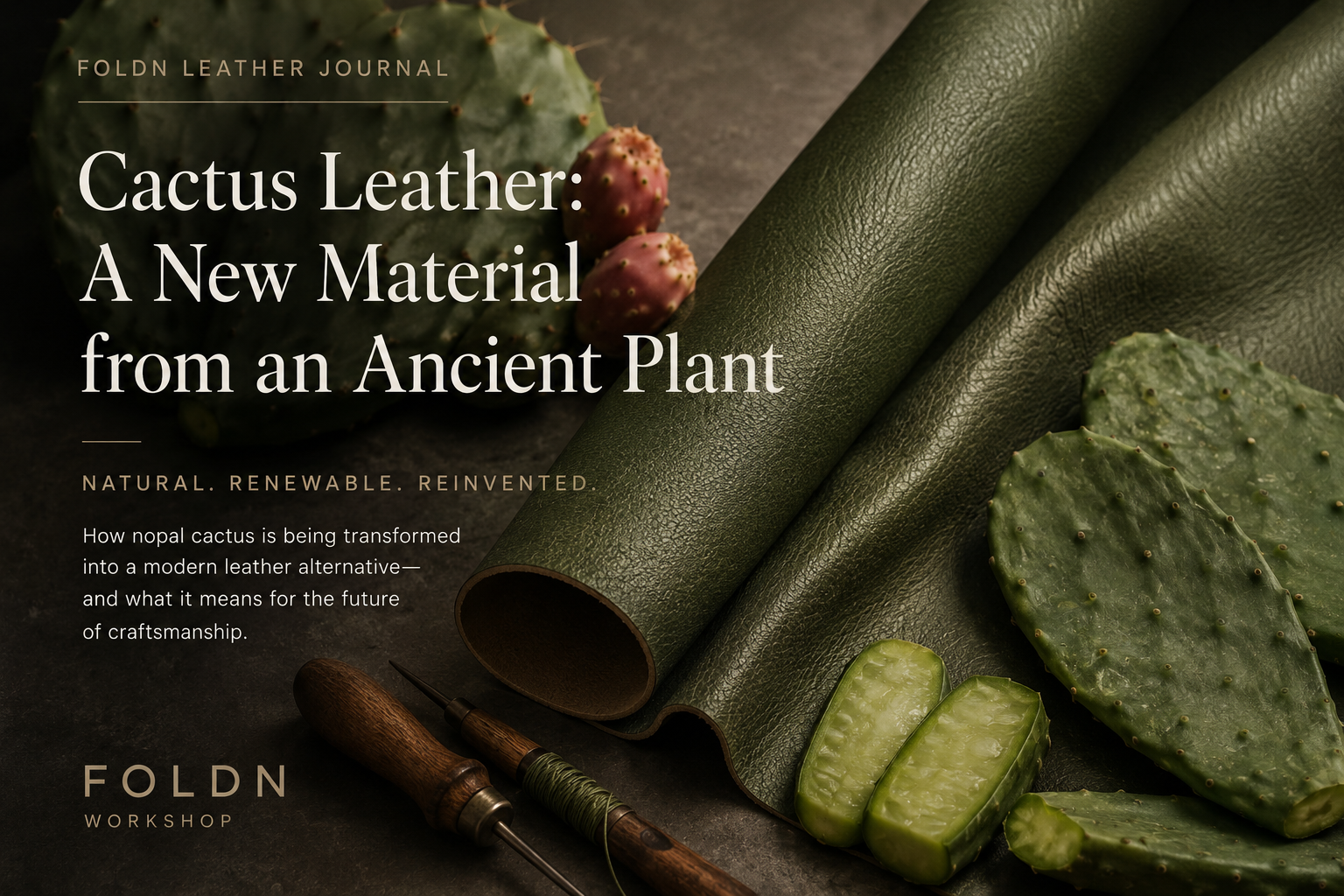
In Mexico, one of the world’s most unexpected materials is being turned into something that looks and feels remarkably similar to leather — the humble nopal cactus, also known as the prickly pear.
The idea sounds almost absurd at first.
A cactus. A plant that survives heat, drought and poor soil. Something associated with deserts rather than handbags, wallets or furniture.
Yet the same qualities that allow the cactus to survive in difficult conditions are part of what makes it interesting as a raw material.
From cactus to material
One of the best-known examples is Desserto, developed in Mexico by entrepreneurs Adrián López Velarde and Marte Cázarez. The material was introduced in 2019 and is made from nopal cactus grown in the Mexican state of Zacatecas.
The process begins with mature cactus leaves.
The plant is not normally destroyed during harvesting. Mature leaves are cut, while the cactus remains alive and can produce new leaves for later harvests. Some producers describe harvesting cycles of roughly six to eight months.
The harvested material is cleaned and dried, traditionally with the help of sunlight. It is then processed to extract plant material that can be incorporated into a flexible leather-like sheet.
The result can be used for bags, wallets, shoes, clothing, accessories, furniture and other products normally associated with leather. The Ellen MacArthur Foundation notes that cactus-based material has already been used in products developed with major fashion and lifestyle companies.
But there is an important distinction.
Cactus leather is not animal leather.
It is a plant-based material designed to reproduce some of the qualities of leather.
That distinction matters.
Is it really made from cactus?
This is where the subject becomes more complicated.
The phrase “cactus leather” can make it sound as though a cactus leaf simply becomes a sheet of material.
It doesn’t.
Modern plant-based leather alternatives are generally composite materials. Their exact composition depends on the manufacturer and product line. Desserto, for example, says that its most advanced materials can be up to 90% bio-based, while the company also describes different formulations across its range.
This means that “cactus leather” should not automatically be interpreted as “100% cactus”.
The cactus is an important biological raw material, but the finished material can contain other components and backing materials.
That is not necessarily a problem.
It simply means that consumers should look beyond the marketing name and ask a more useful question:
What exactly is this particular material made of?
Why cactus?
The attraction of cactus is obvious once you understand the plant.
Nopal cactus is remarkably well adapted to dry conditions. It can grow with relatively little water, and producers working with the material can harvest mature leaves without killing the plant. Some cultivation systems rely heavily on rainfall rather than industrial irrigation.
That makes cactus particularly interesting at a time when the fashion industry is searching for alternatives to resource-intensive materials.
The cactus also has another advantage.
It is already part of Mexican agriculture and food culture.
The parts of the plant that are not used for the material can have other uses, including food production. The goal is therefore not necessarily to grow a plant for a single purpose and throw away the rest, but to use more of what the plant provides.
There is something elegant about that idea.
A plant that has evolved to survive scarcity becomes a source of material designed for a world that is increasingly concerned about scarcity.
Cactus versus traditional leather
It would be easy to turn this into a simple argument:
Animal leather is bad.
Cactus leather is good.
Reality is more interesting.
Traditional leather has qualities that are difficult to reproduce. Good natural leather can be exceptionally durable, repairable and beautiful as it ages. It develops a patina that is difficult to imitate with a manufactured material.
Cactus-based materials have a different set of advantages.
They are plant-based, do not require animal hides and can be produced from a renewable biological resource. Some cactus materials are also designed to reduce the use of conventional fossil-based components.
But the sustainability of any material depends on the entire production system — cultivation, processing, binders, backing fabrics, transportation, finishing and, eventually, what happens to the product when it is discarded.
There is no magic material.
There are only better and worse ways of making things.
The real test is time
There is another question that is perhaps more important than the environmental argument.
How does it age?
This is where cactus-based materials still have something to prove.
Leather has a relationship with time.
A good leather bag may look better after ten years than it did on the day it was bought. Scratches become memories. The surface becomes softer. The colour changes. The object becomes personal.
A new material must earn that same relationship.
It is not enough for a cactus-based material to look beautiful in a photograph or feel pleasant in a showroom.
It has to survive real life.
It has to tolerate being folded, carried, scratched, exposed to rain, placed on tables and opened hundreds or thousands of times.
Only time can answer that question.
And this is perhaps the most interesting part of the cactus leather story.
We are watching a material in its early chapter.
A new chapter in an old craft
Leatherworking itself is not disappearing.
The tools remain.
The cutting.
The stitching.
The shaping.
The finishing.
The patience.
What changes is the material on the workbench.
For a leatherworker, this creates an interesting possibility.
The future may not belong to one material.
A workshop might work with traditional vegetable-tanned leather for one object, recycled materials for another, and plant-based alternatives for something else.
The choice can become part of the design.
The important question is no longer simply:
“Is this leather?”
It is:
“Why was this material chosen?”
That is a much more interesting question.
The cactus does not replace the history of leather.
It adds another possibility to it.
And perhaps that is the real significance of cactus leather.
Not that a desert plant has somehow defeated leather.
But that something as ancient as the craft of making objects from natural materials is still capable of changing.
The workshop remains.
The hands remain.
The desire to make something useful remains.
Only the material is beginning to tell a different story.
A story that starts not in a tannery, but under the Mexican sun.