When buying a leather bag, wallet, belt or accessory, it is easy to assume that a higher price means better leather.
It doesn’t always.
The word “leather” itself tells you surprisingly little about quality. Two products can both be made from genuine leather and still be completely different in durability, appearance, feel and value.
So how can you recognize high-quality leather?
You don’t need to be a leatherworker. You just need to know what to look for.
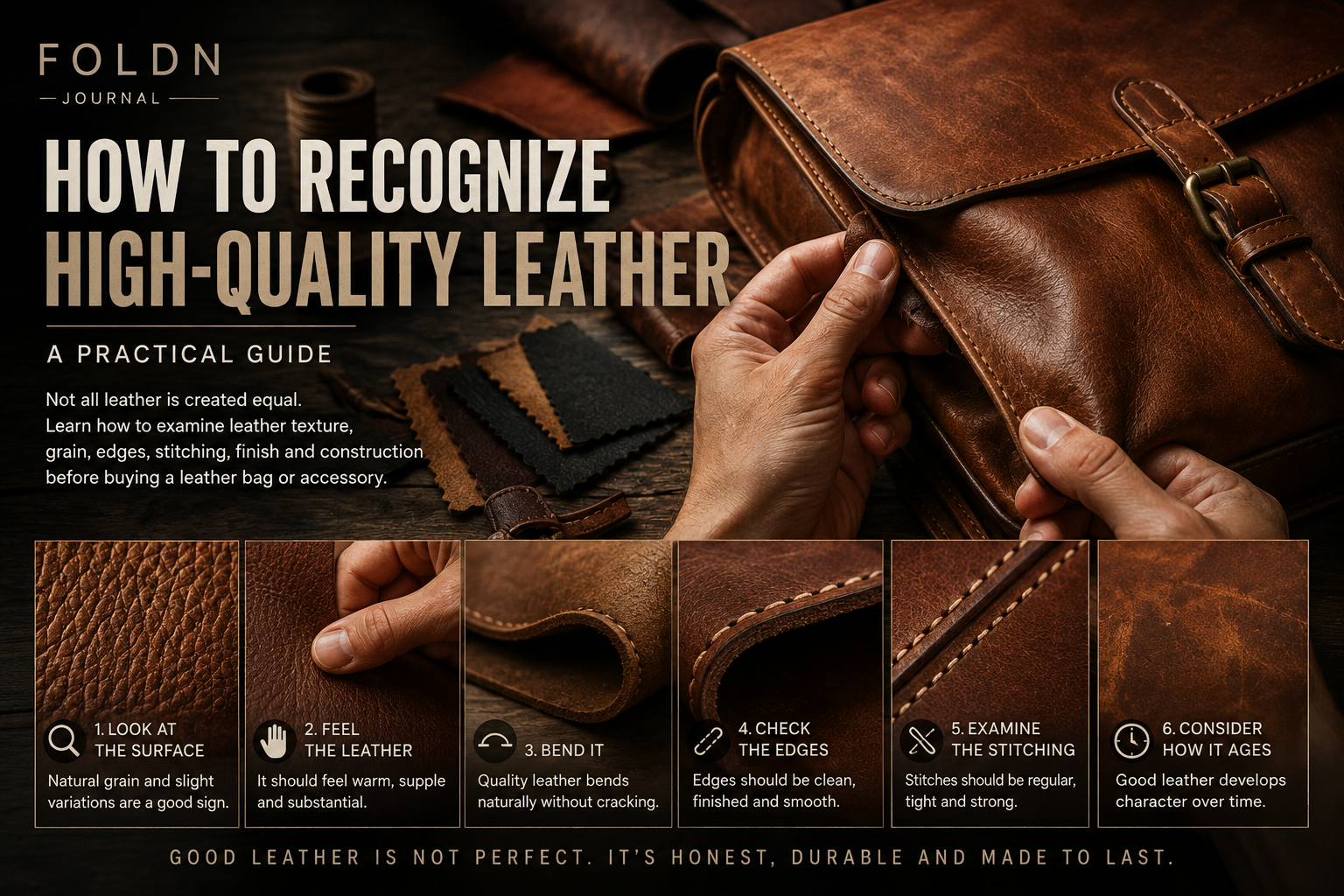
1. Look at the surface
Good leather rarely looks perfectly uniform.
Natural leather has its own grain, pores and small variations. These differences are part of the material’s character.
If a piece of leather looks completely identical from one centimetre to another, it may have been heavily corrected, embossed or coated.
That doesn’t automatically mean it is bad. Corrected leather can be durable and practical. But the surface tells you something about how much of the original grain remains.
High-quality full-grain leather, for example, retains the natural grain of the hide.
2. Feel the leather
One of the simplest tests is also one of the most useful: touch it.
Good leather usually feels substantial and natural rather than like a thin plastic sheet.
It should have some flexibility without feeling weak.
Run your fingers across the surface. Does it feel warm and slightly alive, or completely synthetic and uniform?
Different types of leather naturally feel different, so there is no single “correct” texture. Soft lambskin, firm vegetable-tanned leather and smooth calfskin can all be high-quality while feeling completely different.
The important thing is whether the material feels consistent with what it is supposed to be.
3. Bend it
Gently bend the leather.
Quality leather should respond naturally to movement.
Depending on the finish and type of leather, bending may produce temporary changes in the surface or colour. This is not necessarily a problem.
What you should pay attention to is whether the material feels excessively stiff, brittle or plastic-like.
Very cheap leather can sometimes feel thin and lifeless.
But don’t make the opposite mistake: soft does not automatically mean high-quality.
Some excellent leather is deliberately firm.
4. Examine the edges
Edges reveal a lot about how a leather product was made.
Look at the edge of a bag, wallet or belt.
Is it carefully finished?
Is the construction clean?
Does the edge look like several layers of material glued together carelessly?
On some leather products, especially high-quality handmade goods, the edges are carefully cut, burnished, painted or otherwise finished.
A rough edge doesn’t necessarily mean poor leather, but careless edge construction can indicate poor workmanship.
And leather quality and craftsmanship are two different things.
You can have excellent leather with terrible construction.
You can also have an inexpensive leather with very good workmanship.
5. Look at the reverse side
If you have access to an unfinished edge or the inside of the leather, take a look.
The back of leather can reveal whether you are looking at a solid piece of hide or a material with additional layers.
Suede-like fibres on the reverse side are normal for many types of leather.
But don’t assume that a fuzzy backside automatically proves that the leather is high quality. It doesn’t.
The structure, thickness, finishing and tanning process all matter.
6. Don’t trust the smell alone
People often say that real leather has a distinctive smell.
That’s true to a certain extent.
But smell is not a reliable quality test.
Different tanning methods and finishes can dramatically change the smell of leather. Some high-quality leather may have very little smell, while heavily finished leather can have a strong artificial or chemical odour.
A leather-like smell does not prove quality.
And the absence of smell does not prove that the material is fake.
Use your eyes and hands as well.
7. Check the stitching and construction
A beautiful piece of leather can still become a bad product if it is poorly constructed.
Look closely at the stitching.
Are the stitches regular?
Are there loose threads?
Are the seams straight?
Are stress points reinforced?
On a bag, examine the handles and places where straps are attached. These areas receive much more stress than decorative parts of the product.
Quality is not just about the hide.
Quality is the combination of material, design and construction.
8. Ask what kind of leather it is
If the seller simply says “genuine leather”, ask a second question:
What kind of leather?
There are many different categories and finishing methods.
You may encounter terms such as:
- Full-grain leather
- Top-grain leather
- Corrected-grain leather
- Split leather
- Suede
- Vegetable-tanned leather
- Chrome-tanned leather
- Aniline leather
- Semi-aniline leather
These terms describe different characteristics and production methods.
For example, full-grain leather retains the natural grain of the hide, while corrected-grain leather has been mechanically altered to create a more uniform surface.
Neither category automatically answers every question about durability or suitability.
A leather product should be judged according to what it is designed to do.
9. Look for excessive coating
Some leather products have a very heavy surface coating.
This can make the material extremely uniform and resistant to stains, but it can also hide much of the natural character of the leather.
A heavily coated surface may look almost like plastic.
Again, that does not automatically make it poor quality.
Sometimes a protective finish is exactly what a product needs.
A travel bag, for example, may benefit from a durable finish that protects it from rain and everyday wear.
The question is not simply:
“Is it coated?”
The better question is:
“Is the finish appropriate for the purpose?”
10. Price is not a quality test
One of the biggest mistakes buyers make is assuming that expensive automatically means good.
A designer label can dramatically increase the price of a leather bag without changing the underlying material proportionally.
At the same time, a relatively inexpensive handmade product can contain excellent leather.
Price tells you what the seller is asking.
It does not tell you everything about the material.
Learn to inspect the product instead.
11. Good leather changes with time
Perhaps the most interesting characteristic of good leather is what happens after you buy it.
Leather is not static.
It can darken.
It can soften.
It can develop scratches and marks.
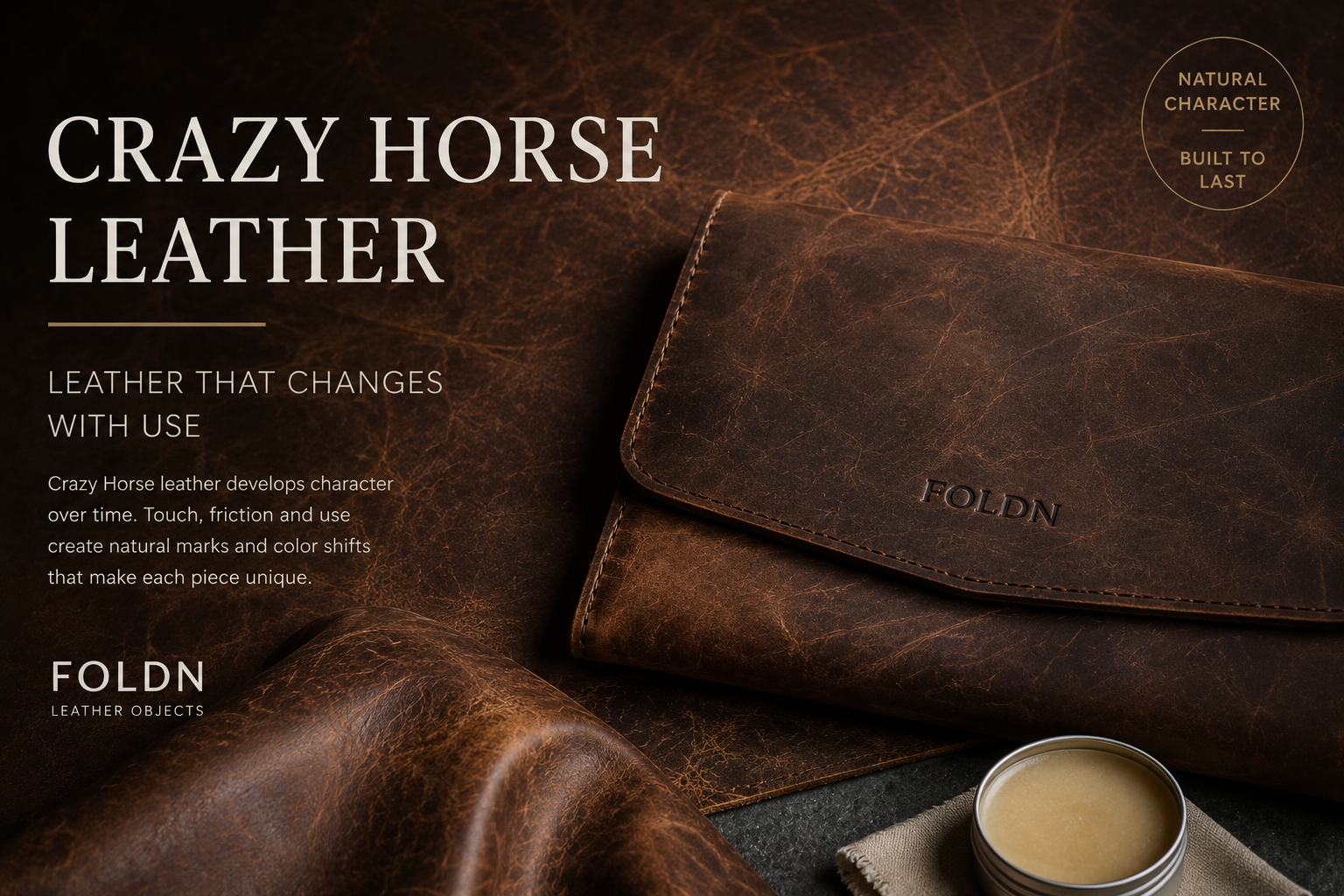
Vegetable-tanned leather, in particular, can develop a rich patina as it is handled and exposed to light and everyday use.
This is one of the reasons leather can become more personal with age.
A new synthetic surface may be designed to remain visually identical for as long as possible.
Leather often tells a different story.
It records use.
A wallet develops marks from a person’s hands.
A bag develops wear around the handles.
A belt changes shape according to its owner.
These signs are not necessarily damage.
Sometimes they are the history of the object.
Quality is more than the leather itself
There is no single test that can tell you whether a piece of leather is “good”.
Quality depends on several things:
The hide.
The tanning process.
The finishing.
The thickness.
The construction.
The intended use.
And the workmanship.
A soft leather may be perfect for a glove but unsuitable for a structured bag.
A firm leather may be excellent for a belt but uncomfortable for clothing.
A heavily finished leather may be ideal for everyday use.
There is no universal winner.
The best leather is the leather that performs well for its intended purpose.
The best test is time
Perhaps the most honest test of leather is not what it looks like in a shop.
It is what happens after years of use.
Does it crack?
Does the surface deteriorate?
Do the seams hold?
Does the material become more comfortable?
Does it develop character?
A well-made leather object should not necessarily look exactly the same after five or ten years.
It should look lived in.
That is one of the qualities that makes leather different from so many modern materials.
You don’t simply buy leather.
You buy a material that continues to change.
And sometimes, the older it gets, the better the story becomes.