Floater leather is one of the most recognizable types of leather, known for its soft feel, natural-looking grain and practical resistance to everyday use. Its distinctive textured surface gives leather goods a relaxed, durable character while remaining comfortable and flexible.
What is floater leather?
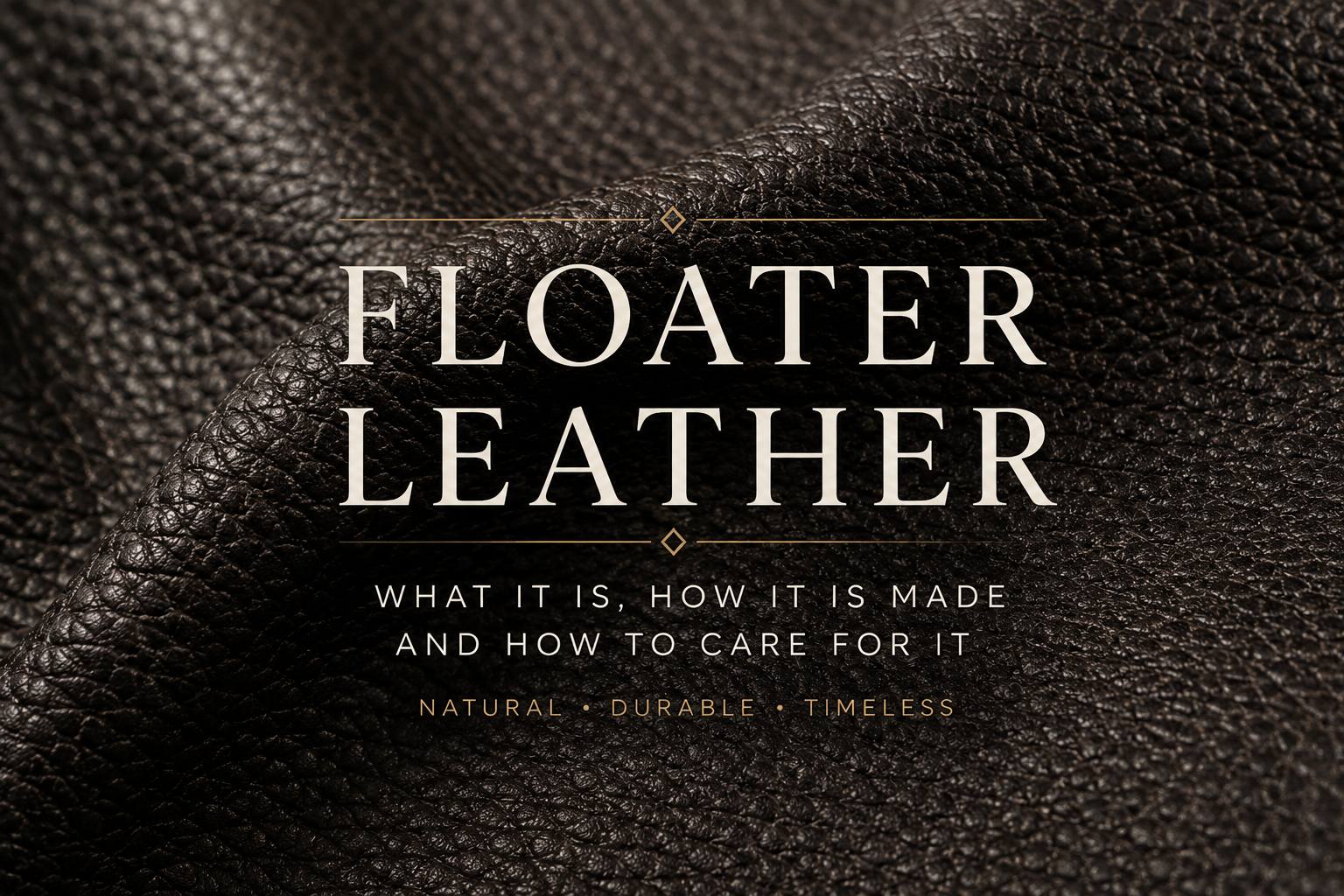
Floater leather is leather with a pronounced, pebbled grain surface. The grain can be naturally developed or enhanced during the finishing process, depending on the type and quality of the leather.
Unlike completely smooth leather, floater leather has a textured surface with small irregular patterns. These patterns can range from fine and subtle to relatively large and pronounced.
The term floater is commonly used in the leather industry for soft, flexible leather with a characteristic grain finish. It is particularly common in leather used for bags, wallets, footwear, jackets, cases and other everyday objects.
How is floater leather made?
The process begins with an animal hide that is cleaned, tanned and prepared for finishing.
After tanning, the leather may undergo several processes designed to give it the desired softness, thickness, colour and surface appearance. In many types of floater leather, the characteristic grain is created or emphasized through mechanical finishing, embossing or controlled tumbling.
Tumbling is particularly important for some soft leathers. The hides are placed in large rotating drums, where mechanical movement helps soften the material and develop a more relaxed, natural-looking grain.
The exact production method varies between manufacturers and different grades of leather.
This means that two leathers both described as “floater leather” can feel and behave quite differently.
The characteristic grain
The most obvious feature of floater leather is its surface.
The pebbled grain gives the leather depth and makes the surface less uniform than smooth leather. This texture also has a practical advantage: minor scratches, wrinkles and marks are generally less noticeable on a textured surface.
That makes floater leather particularly suitable for objects that are handled frequently.
A smooth, polished surface can show every small imperfection. A textured leather tends to absorb these signs of use visually.
Softness and flexibility
Floater leather is often associated with softness and flexibility.
However, softness is not a fixed characteristic of all floater leather. It depends on the animal hide, tanning method, thickness, finishing and subsequent treatment.
A thin floater leather can be very supple and flexible, while a thicker version can retain considerable structure.
This versatility is one reason why floater leather is used for such a wide range of products.
Durability
Good-quality floater leather can be highly durable.
The textured surface is practical for everyday use because small scratches and surface marks tend to blend into the grain. The leather can also develop a distinctive appearance as it ages.
But durability depends heavily on the quality of the hide and the way it has been processed.
The word “floater” by itself does not guarantee superior quality.
A well-made leather from a good hide can last for many years, while a lower-quality leather with an artificial or heavily corrected surface may have very different characteristics.
Natural grain and embossed grain
It is important to distinguish between natural grain and embossed grain.
Natural grain refers to the original surface structure of the hide. When leather is embossed, a pattern is mechanically pressed into the surface to create a particular appearance.
Some floater leathers have a grain that is largely natural, while others have a deliberately created or enhanced pebble pattern.
This distinction matters because the appearance of a textured leather does not necessarily tell you how much of the original grain remains.
Why does floater leather develop character?
Leather is a material that changes with use.
Friction, contact with the hands, exposure to the environment and repeated bending gradually affect its surface.
On floater leather, these changes interact with the existing grain pattern. Over time, the leather can become softer and develop subtle variations in colour and texture.
This ageing process is often considered one of the attractive qualities of genuine leather.
The object does not necessarily become less beautiful because it has been used.
It becomes different.
How to care for floater leather
Floater leather generally does not require complicated maintenance.
Dust and surface dirt can usually be removed with a soft, dry cloth. If necessary, a slightly damp cloth can be used, but the leather should not be soaked.
Harsh detergents, excessive water and strong solvents should be avoided.
Leather conditioners can sometimes be useful, but they should be applied sparingly and only when appropriate for the particular finish. An unsuitable product can darken the leather, alter its texture or leave an unwanted residue.
Before applying any treatment to a valuable leather object, it is sensible to test the product on a small, inconspicuous area.
Floater leather compared with smooth leather
The main difference between floater and smooth leather is the surface.
Smooth leather emphasizes an even, clean appearance. Floater leather emphasizes texture.
Smooth leather can have a more formal and refined appearance, while floater leather often feels more relaxed and practical.
Neither is inherently better.
The right choice depends on the object, the intended use and the appearance that is desired.
Is floater leather real leather?
Yes, floater leather can be genuine natural leather.
However, the term itself describes a type of leather and surface character rather than a universal quality grade.
When buying leather goods, it is therefore useful to look beyond the word “floater” and find out what type of leather is being used, how it was finished and how thick it is.
Terms such as full-grain, top-grain, corrected-grain and split leather describe different aspects of the material and can provide more information about its construction and quality.
A leather made for everyday use
Floater leather has become popular because it combines several qualities that work well together: texture, softness, flexibility and practicality.
Its surface does not demand perfection.
Small marks can become part of the appearance rather than obvious defects. With proper care, good floater leather can remain attractive and functional for years.
That is perhaps the most interesting quality of the material.
Floater leather is not about preserving a perfect surface. It is about creating a surface that can live, change and acquire character through use.