Leather is usually made into something that surrounds an object.
A sheath. A case. A bag. A cover.
But there is another possibility: leather can become the object itself.
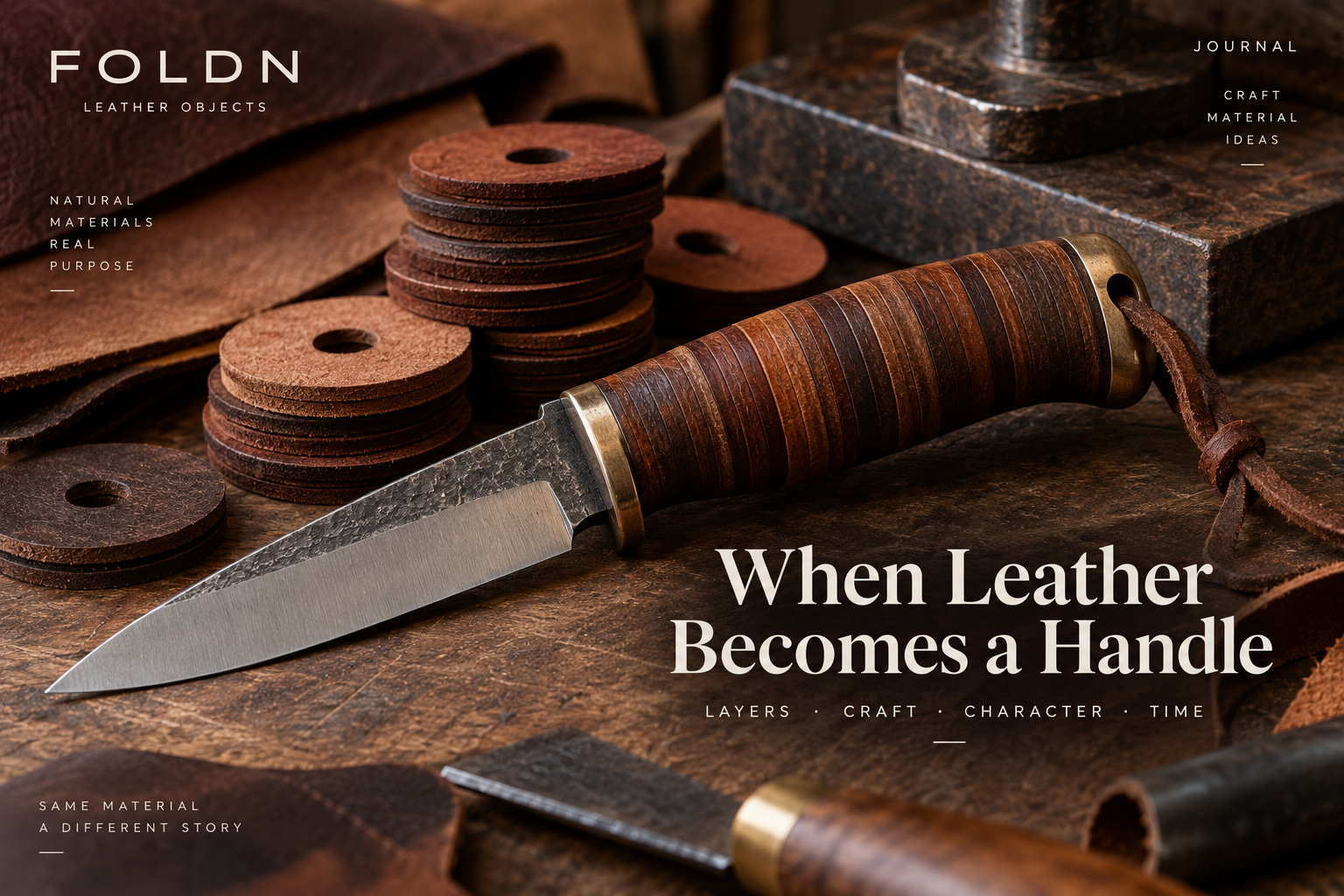
One of the most distinctive examples is the stacked leather handle — a handle made from layers of leather compressed together until they form a solid, tactile material.
It is an old technique, but it still feels surprisingly modern.
A handle made from layers
A stacked leather handle does not begin as a single piece of material.
It begins with many.
Small pieces of firm leather are cut with an opening for the tang of the knife. The pieces are then assembled one after another, compressed and fixed together.
Once the leather has become a dense block, its outside can be shaped into the final form.
The principle is simple:
many pieces become one object.
That transformation is what makes the technique interesting from a leatherworker’s point of view.
Why leather?
Wood is hard.
Metal is cold.
Synthetic materials can be extremely durable.
Leather is different.
It has a certain softness without becoming shapeless. It has friction, warmth and a surface that changes through use.
Stacked leather handles have traditionally been valued for their comfortable grip, particularly in outdoor and hunting knives. The material also feels warmer in cold conditions than many conventional handle materials.
But the attraction is not only practical.
It is also visual.
The individual layers remain part of the story of the object.
The importance of compression
The secret of a good stacked leather handle is not simply putting leather pieces next to each other.
The layers need to become compact.
Traditional methods use pressure to compress the leather before or during assembly. Some makers compress the leather while it is wet and allow it to dry under pressure; others assemble dry pieces and rely on mechanical compression and adhesive.
This changes the character of the material.
Loose pieces become a single dense structure.
The leather no longer behaves like a collection of separate scraps. It becomes something that can be shaped almost like a solid material.
The beauty of the edge
One of the most beautiful things about stacked leather is the edge.
When the handle is shaped, the layers reveal themselves.
Depending on the leather and the construction, they can appear as subtle horizontal lines or as a more pronounced pattern running through the handle.
The effect is completely different from a conventional leather wrap.
A wrapped handle says:
leather is covering this object.
A stacked handle says:
leather is this object.
That distinction matters.
Not every piece has to look perfect
Natural leather has variations.
A slightly different grain.
A darker section.
A small mark.
A change in thickness.
In a large leather panel, these differences may be something a maker tries to avoid.
In a stacked handle, they can become part of the design.
The individual layers create a rhythm, and small variations give the finished handle a handmade character that would be difficult to reproduce perfectly.
This is one reason why leftover pieces of suitable leather can sometimes find a second life in stacked construction. The technique has historically been associated with using leather pieces and offcuts.
From square to form
The leather stack does not have to begin in its final shape.
In traditional making, oversized pieces can be assembled first and shaped afterwards.
The maker gradually removes material until the handle acquires its final profile.
This is where the object becomes personal.
A handle can be slim or substantial.
Straight or gently curved.
Minimal or strongly sculpted.
The final form is not determined by the leather pieces alone. It is determined by the relationship between the material and the hand.
Leather changes with time
A new leather handle can look almost too perfect.
Then it begins to live.
Hands touch it.
The surface becomes smoother.
The colour deepens.
Small marks appear.
The edges become polished by use.
Leather has always had this quality. It does not simply remain the same material that left the workshop.
It records contact.
That is especially interesting in a knife handle because the hand touches the same surface again and again.
The object gradually becomes personal.
A material with limitations
Leather is not indestructible.
A stacked leather handle needs reasonable care. Prolonged moisture, neglect and unsuitable storage can eventually damage leather. If it is not properly maintained, leather can become brittle or deteriorate over time.
That is not necessarily a weakness.
Natural materials always have conditions.
Wood needs care.
Metal oxidises.
Leather changes.
The point of using a natural material is not to make something that never changes.
It is to make something that changes honestly.
The quiet construction
There is something almost architectural about a stacked leather handle.
Layer after layer.
Pressure.
Alignment.
Time.
Then shaping.
What begins as a pile of small pieces becomes one continuous form.
There are no complicated patterns required.
No decoration needs to be added afterwards.
The construction itself provides the visual language.
This is very close to the way we think about leather at FOLDN.
We are interested in what happens when leather is allowed to become more than a surface.
Not decoration.
Not imitation.
Material.
From scrap to object
Perhaps the most interesting lesson of stacked leather is that a material does not have to begin as a large, perfect sheet to become valuable.
Small pieces can be organised.
Compressed.
Combined.
Shaped.
And transformed into something with a completely different identity.
The leather remembers its layers.
But the hand sees one object.
That is the beauty of the technique.
Many pieces of leather. One handle. One object.