There are leathers that simply cover an object.
And then there is crocodile leather.
It does not disappear into the design. It becomes part of it.
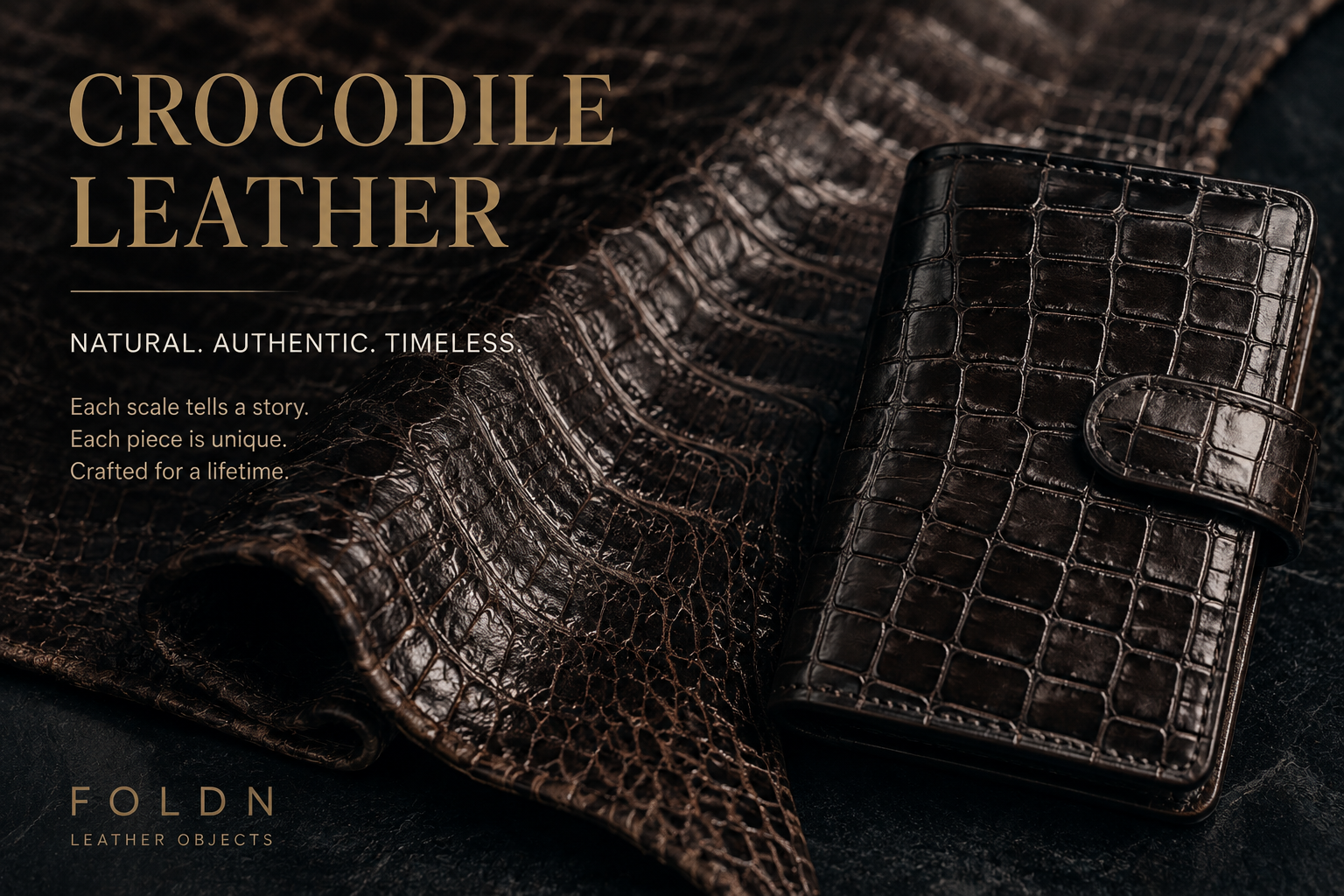
Every scale, every line and every natural variation gives the surface its own character. Unlike uniform manufactured materials, genuine crocodile leather carries the irregularity of nature with it. No two skins are exactly alike, and no two finished objects will ever be completely identical.
That is one of the reasons crocodile leather has occupied a special place in leathercraft for centuries.
A leather unlike ordinary leather
Crocodile leather is valued not simply because it is rare or expensive.
Its attraction begins with its structure.
The surface is composed of distinctive scales arranged in natural patterns. Depending on the species and the part of the hide used, these scales can be relatively small and symmetrical or larger and more pronounced. The centre of the belly usually provides the most recognizable pattern, while the flanks and other areas have a different, more irregular character.
For a leatherworker, this matters.
The skin is not an anonymous sheet of material. It already contains a visual language.
The maker’s task is not to hide it, but to work with it.
The belly, the flank and the character of the skin
One of the most recognizable forms of crocodile leather comes from the belly.
The scales in this area tend to be broader and more regular, creating the pattern most people associate with luxury crocodile goods. This makes belly leather particularly attractive for handbags, wallets, watch straps, small leather goods and other objects where the surface itself becomes a central part of the design.
The flanks tell a different story.
The scales become less uniform and more dynamic. For some makers, this irregularity is precisely what makes the material interesting. It feels less formal and more connected to the animal from which the leather originated.
There is no universally “better” part.
There is only a different character.
Where crocodile leather is used
Genuine crocodile leather can be used for a wide range of leather objects.
Its most familiar applications include:
Wallets and card holders — where the scale pattern can be displayed on a relatively small surface.
Bags and cases — where larger sections of the hide allow the natural pattern to become part of the architecture of the object.
Watch straps — where crocodile leather has long been appreciated for its distinctive appearance and ability to develop character with use.
Belts and accessories — particularly where a strong surface texture is desirable.
Small leather objects — boxes, covers, pouches, document cases and other handmade pieces can benefit from the material’s visual presence.
Furniture and interior details — in selected applications, crocodile leather can be used as an accent material rather than simply as a covering.
The possibilities are broad, but the material demands restraint.
Crocodile leather is already visually strong.
It rarely needs decoration for the sake of decoration.
The importance of craftsmanship
Working with crocodile leather is not simply a matter of cutting a piece and sewing it together.
The maker has to understand the skin.
Where should the centre line run?
Which scales should remain visible?
Where should a seam pass?
How will the pattern change when the leather bends?
How should the object be constructed so that the natural character of the skin remains visible?
These decisions can determine whether the finished object looks considered or careless.
With an ordinary piece of leather, a small mistake may disappear into the surface.
With crocodile leather, it can become part of the pattern.
That makes the material demanding.
It also makes it rewarding.
Natural variation is not a defect
Modern manufacturing has taught us to expect perfection.
The same colour.
The same texture.
The same dimensions.
The same product repeated thousands of times.
Natural crocodile leather belongs to another world.
There may be differences in scale size, colour, texture and surface character. Small natural variations are part of the material’s identity.
For FOLDN, this is important.
We are interested in materials that show where they come from.
A natural surface should not necessarily look like plastic. It should have variation. It should have depth. It should change with light and use.
The object should remain an object — not become a perfect imitation of one.
Crocodile leather and time
One of the most interesting qualities of good leather is its relationship with time.
A new object has one character.
After years of handling, another appears.
The surface is touched, folded, carried and exposed to its environment. Depending on the finish, the leather can develop changes in colour, gloss and texture.
This is particularly interesting with a handmade object.
A mass-produced object is often expected to remain exactly the same.
A handmade leather object can become a record of its owner’s life.
That difference matters.
Not all crocodile leather is the same
“Crocodile leather” is often used casually to describe several different exotic leathers.
But crocodilian skins come from different species, and their appearance and characteristics can vary considerably. Alligator, caiman and crocodile are not simply different names for the same material.
The tanning process also matters.
A skin can be finished in different ways, producing very different surfaces — from highly polished and formal to softer, more natural and understated.
Colour changes the character again.
Black can make the scale pattern architectural.
Brown can emphasize the natural depth of the skin.
Deep green, burgundy or other colours can make the surface more expressive.
The material remains the same family of leather.
The personality changes.
A material that should not be wasted
Because crocodile leather is a specialized and valuable material, thoughtful cutting is particularly important.
A skilled maker plans around the skin rather than treating it like an unlimited sheet of material.
The scale pattern, usable areas and construction of the object all have to be considered before the first cut.
This is one of the fundamental differences between industrial production and traditional leathercraft.
The industrial approach often begins with a predetermined shape.
The craftsman begins with the material.
He looks at it.
Turns it over.
Studies the surface.
Finds the strongest section.
And only then decides what the material wants to become.
The ethics behind exotic leather
There is also another side to crocodile leather that cannot simply be ignored.
Authentic exotic leather should come from legal and traceable sources and comply with the relevant wildlife-trade regulations. Depending on the species and country of origin, international trade may be regulated under CITES, the Convention on International Trade in Endangered Species of Wild Fauna and Flora.
For a serious maker, provenance matters.
Luxury should not mean ignorance.
The material should be understood from beginning to end — where it came from, how it was processed and how it became an object.
Why crocodile?
The answer is not simply status.
Crocodile leather has something that many modern materials have lost:
presence.
You can see the animal in the material.
You can see its natural structure.
You can feel that the surface was not designed by a computer.
And when a skilled craftsman works with it carefully, the final object becomes something more than a container, wallet, strap or case.
It becomes a meeting point between nature and human work.
The skin existed before the object.
The craftsman gives it a second life.
And the owner eventually gives it a third — through years of use, handling and memory.
That is what makes genuine crocodile leather fascinating.
Not perfection.
Not fashion.
Not a logo.
Character.