There are objects we use.
And there are objects we become attached to.
The difference is not always in the function. A leather case can hold the same things as a synthetic case. A leather bag can carry the same belongings as a nylon bag. A leather wallet can do exactly what a plastic wallet does.
So why does the material change the feeling?
Because leather is not neutral.
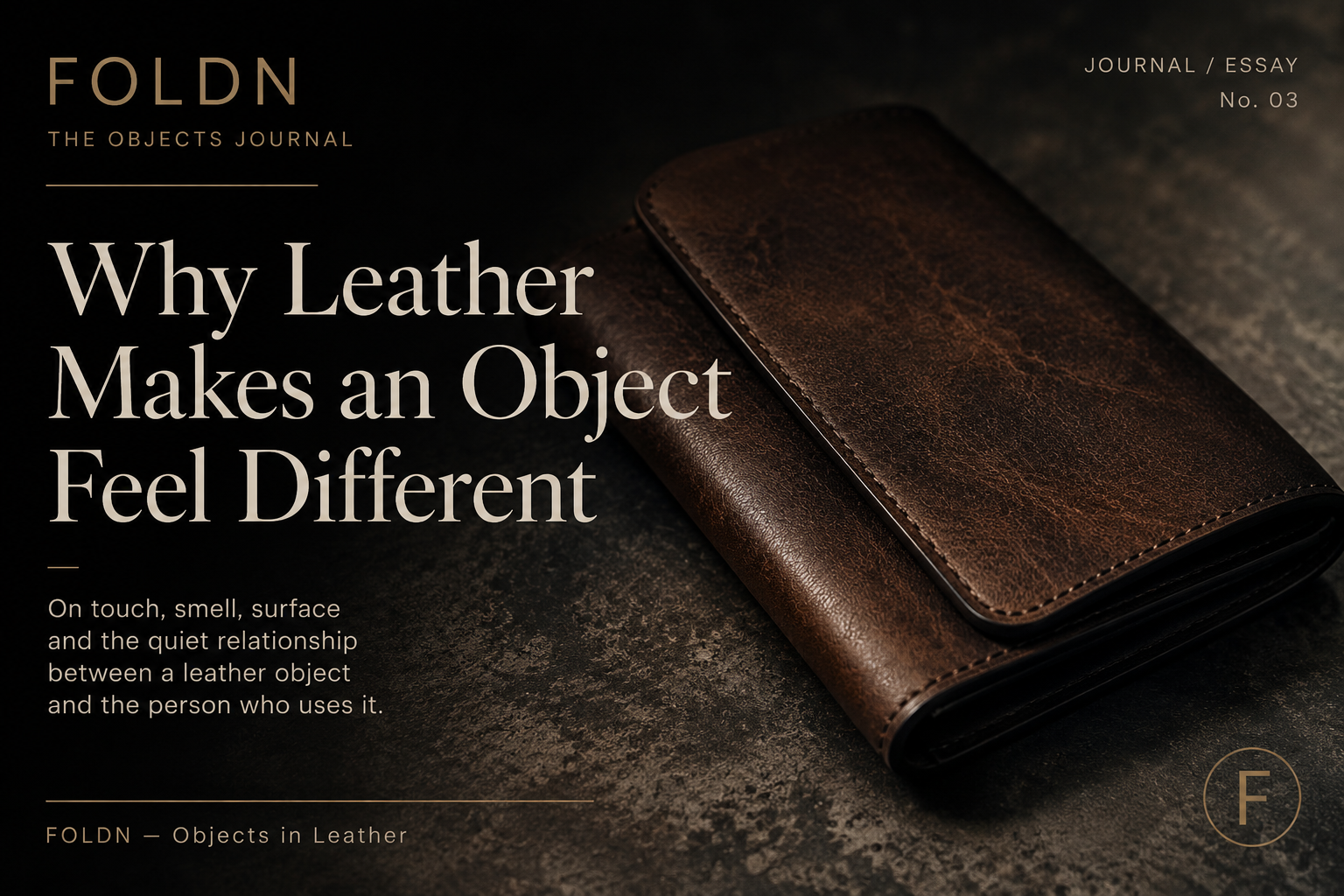
The first thing you notice is the surface. Leather has a texture that cannot be completely standardised. It can be smooth, rough, soft, firm, matte or slightly glossy. No two pieces are entirely identical.
Then there is the smell.
A new leather object has a presence before you even use it. You can recognise the material without seeing it. This is unusual in a world filled with synthetic surfaces that often try to imitate one another.
Then comes touch.
Leather responds to the hand. It bends when you bend it. It becomes softer where it is handled. It develops marks where it meets keys, coins, documents, glasses or whatever else we carry with us.
This is important.
A leather object does not remain completely separate from its owner.
It records contact.
A pocket wallet becomes shaped by a pocket. A small case becomes familiar through constant handling. A bag develops its own character through the way it is carried.
The object slowly becomes specific.
Not just a leather bag.
Your leather bag.
This is one of the reasons leather has remained relevant despite decades of new materials. Technology can make objects lighter, cheaper and more efficient, but it cannot completely reproduce the feeling of handling a natural material.
Leather has imperfections.
And those imperfections are part of its identity.
A small variation in grain does not mean the material is defective. It means the surface has a history before the object itself existed. The maker does not create every detail from nothing. Some of them are already there.
This changes the philosophy of the object.
A leather product does not need to shout.
It can be quiet.
A simple shape, good leather and careful construction can be enough. There may be no unnecessary hardware, no large logo and no decoration designed to attract attention from across the room.
The material does the talking.
Perhaps that is what makes leather objects particularly interesting today.
We have more products than ever, but fewer objects that feel personal.
Leather sits somewhere between utility and intimacy.
You buy it because you need something.
You keep it because, after a while, it becomes something else.
It becomes familiar.
And that may be the real value of a leather object.
Not simply what it carries.
But what it becomes while carrying it.