Before modern factories learned to make leather quickly, there was time.
Time for bark to release its tannins.
Time for hides to absorb them.
Time for the material to change.
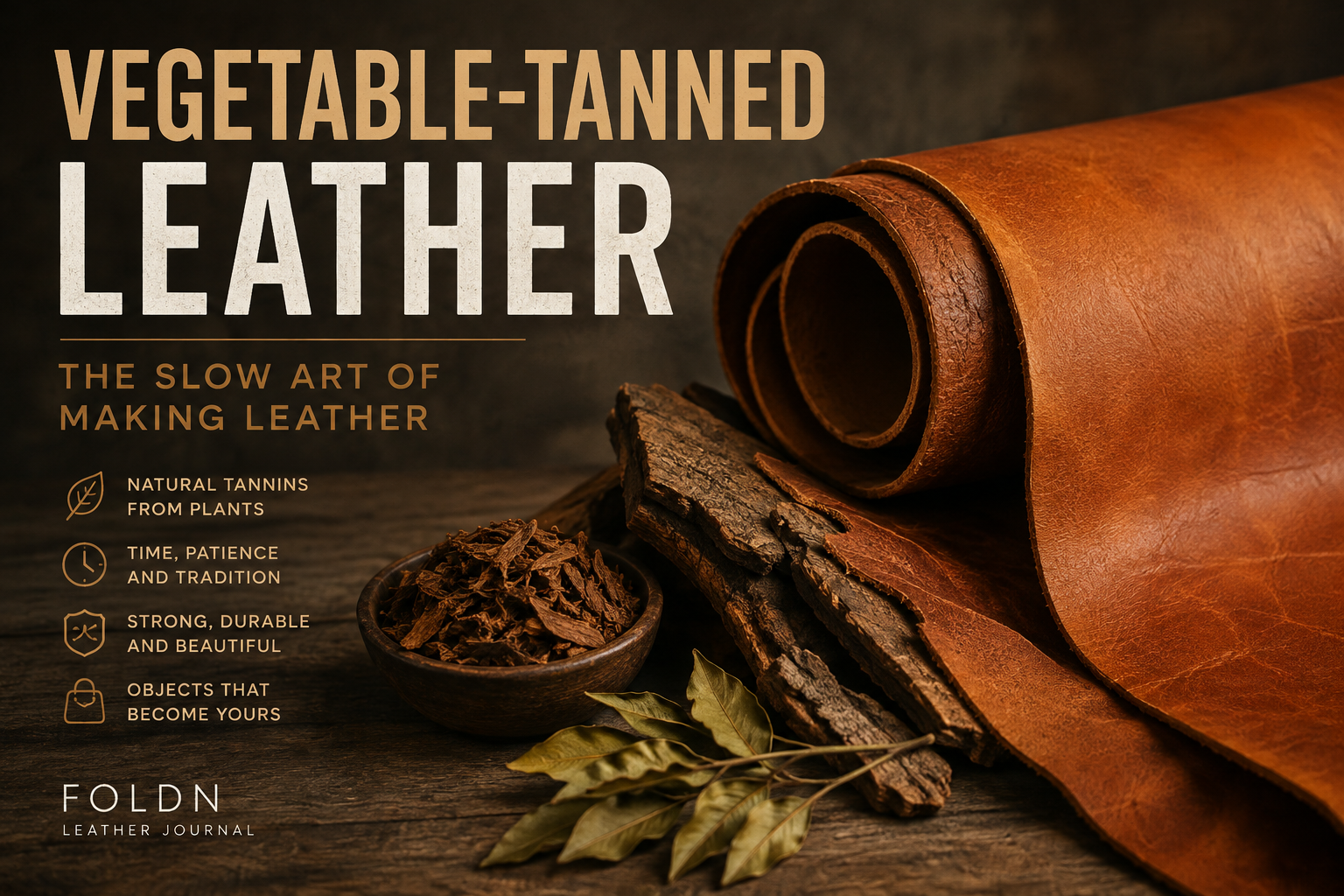
This older method is known as vegetable tanning.
It is one of the oldest ways of transforming animal hide into leather, and it remains one of the most respected techniques among traditional leatherworkers today.
Leather made with plants
The name comes from the materials used in the process.
Vegetable tanning relies on tannins — naturally occurring compounds found in plants. Oak, chestnut, mimosa and other trees and plants can provide these tannins.
The basic principle is simple, but the process is not.
A raw hide is cleaned and prepared before being placed into tanning solutions. The tannins gradually penetrate the hide and stabilize its collagen structure, turning something that would otherwise decay into a durable material.
Traditionally, this could take weeks or even months.
There was no shortcut.
And that slowness became part of the character of the leather.
A material that changes
Fresh vegetable-tanned leather often has a relatively pale, warm colour.
But it does not remain that way.
Light changes it.
Hands change it.
Oil changes it.
Time changes it.
A wallet carried every day may become darker and warmer. A bag exposed to sunlight can develop a deep, rich colour. Areas touched frequently may become smoother and more polished.
This gradual transformation is known as patina.
It is one of the reasons people become attached to vegetable-tanned leather.
The object does not simply become older.
It becomes different.
Every piece tells a story
Vegetable-tanned leather tends to show the natural character of the hide.
Small variations in grain, colour and texture remain visible. Scars and marks may appear. Two pieces from the same hide can look surprisingly different.
For industrial production, this can be inconvenient.
For a craftsman, it can be beautiful.
The material itself becomes part of the design.
A perfectly uniform sheet may be easier to manufacture with, but natural variation gives an object something that cannot be reproduced exactly.
No two pieces age in precisely the same way.
The smell, the feel, the weight
There is also something physical about vegetable-tanned leather that photographs cannot communicate.
The smell.
The firmness of a new hide.
The way the material bends.
The sound of a thick piece being folded.
The gradual softness that appears after years of handling.
Leather is not only something we see.
It is something we touch.
And perhaps this explains why leather objects have remained relevant even as so many other materials have disappeared from everyday life.
They offer a physical relationship with the object.
Why is vegetable-tanned leather expensive?
The answer is partly time.
Traditional vegetable tanning generally takes longer than faster industrial tanning methods. It also requires specialized knowledge and careful control of the process.
But price is not determined by tanning alone.
The quality of the hide matters. The cutting matters. The amount of usable leather matters. Craftsmanship matters. Finishing matters.
And there is another factor that is easy to overlook:
waste.
When a craftsman works with a natural hide, it is not a perfect rectangle. Its shape changes. Some areas are stronger than others. Natural marks have to be considered when cutting the pieces.
A good craftsman learns to work with the hide rather than against it.
Vegetable tanning and the environment
Vegetable tanning is often described as a more natural form of leather production, and it does have important differences from chrome tanning.
But “natural” does not automatically mean “environmentally harmless.”
Vegetable tanning still requires water, energy, chemicals and infrastructure. The environmental impact depends on where and how the leather is produced, what tanning agents are used, how wastewater is treated and how the entire production chain is managed.
So the interesting question is not simply whether vegetable tanning is “green.”
It is whether the material is well made, responsibly produced and used for a long time.
A leather object that survives for decades has a very different relationship with resources from an object designed to be replaced every year.
The craftsman’s material
For a leatherworker, vegetable-tanned leather offers something special.
It responds.
It can be cut cleanly. It can be moulded. It can be burnished. It can develop a beautiful edge. It can be dyed, stamped, carved and finished in different ways.
Most importantly, it changes as the craftsman works with it.
The material is not completely passive.
It has its own character.
A good craftsman learns to understand that character.
Slow leather in a fast world
Perhaps that is why vegetable-tanned leather feels strangely modern today.
We live surrounded by things designed for speed.
Fast fashion. Fast delivery. Fast production. Fast replacement.
Vegetable tanning represents almost the opposite idea.
Take a natural material.
Give it time.
Make something from it.
Use it.
Repair it.
Keep it.
Let it change.
There is no need for the object to remain frozen in its original condition.
Its purpose is not to stay new.
Its purpose is to last.
And perhaps that is the real beauty of vegetable-tanned leather.
It does not promise to remain unchanged.
It promises something more interesting:
to become yours.