Walk into a shop selling leather goods and you will often see the same words everywhere: premium leather, genuine leather, luxury leather, handcrafted leather.
But what do these words actually tell us?
Sometimes, very little.
Good leather does not always need an impressive label. In many cases, you can learn more by looking closely, touching the material and understanding how it behaves.
Leather has a language of its own.
You just have to learn how to read it.
Start with the surface
Natural leather rarely looks perfectly uniform.
You may see small variations in grain, subtle changes in colour, tiny marks or differences in texture. These are not necessarily imperfections. They can be signs that the material retains part of the character of the original hide.
A completely identical surface can sometimes indicate heavy correction or artificial finishing.
That does not automatically mean the leather is bad. Corrected leather can be useful and durable.
But it is different from leather whose natural grain remains visible.
Touch the leather
One of the simplest tests is also one of the best.
Good leather should feel like a material rather than a plastic surface.
Depending on the type, it may be firm, soft, smooth, dry, oily or slightly textured. There is no single correct feeling because different kinds of leather are made for different purposes.
A leather belt should not feel like a soft handbag.
A wallet does not need the same flexibility as a pair of shoes.
The important thing is that the material feels consistent with what it is supposed to do.
Look at the edges
Edges can tell you a surprising amount.
On a leather bag, wallet or case, examine the cut edges.
Are they carefully finished?
Are the layers visible?
Does the edge feel rough and unfinished?
High-quality craftsmanship is often easiest to see in places that nobody notices from a distance.
A beautiful front surface can hide poor construction.
A carefully finished edge is much harder to fake.
Look at the grain
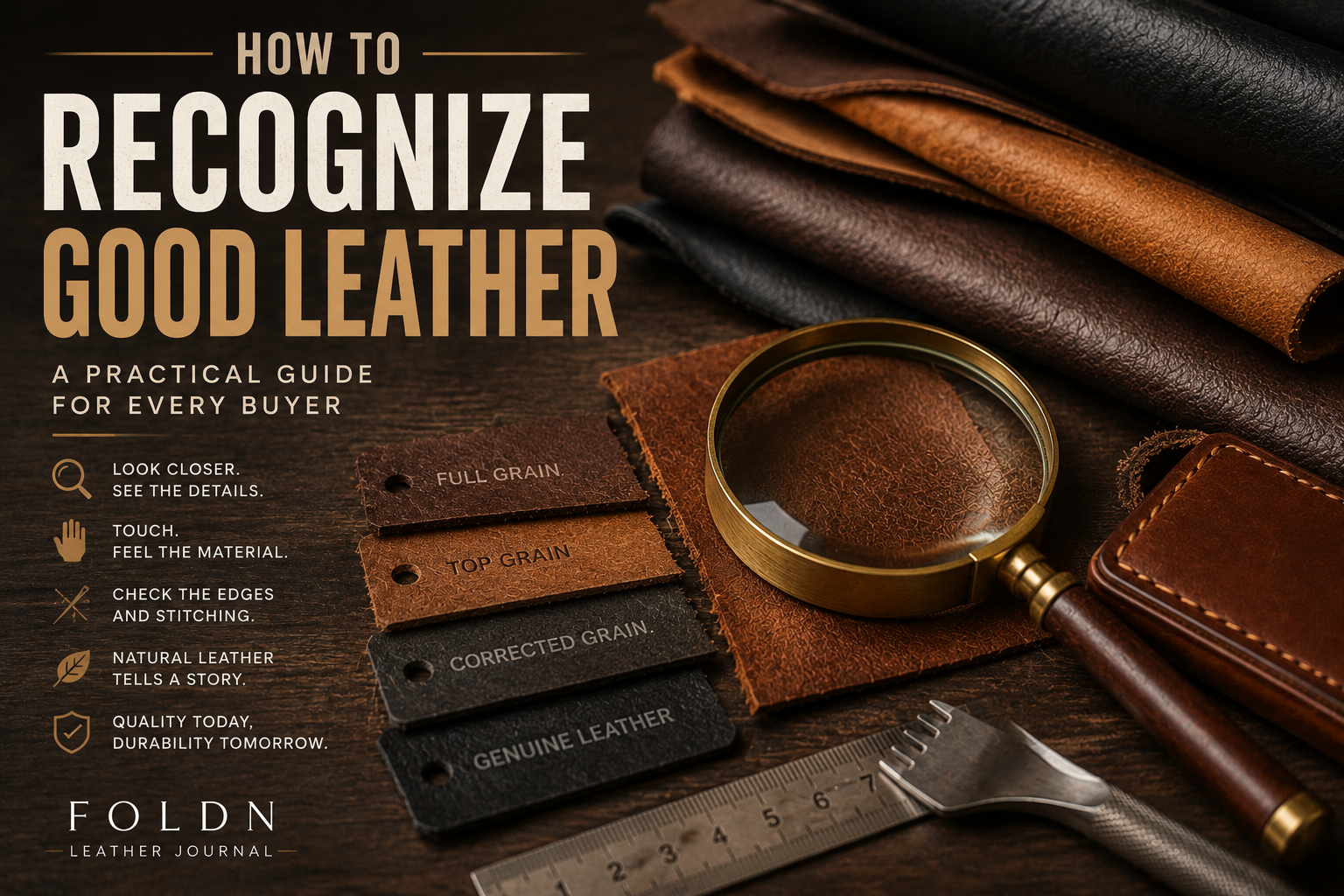
Leather has different grain structures, and understanding them helps when choosing a product.
Full-grain leather retains the natural outer layer of the hide. It can develop a strong patina and is often valued for its durability and character.
Top-grain leather has also retained much of the original grain, but the surface may have been lightly corrected or refined.
Corrected-grain leather has been more heavily processed to create a more uniform appearance.
None of these categories automatically tells you whether a particular product is excellent.
Construction still matters.
A beautiful piece of leather can be badly made.
A simpler piece of leather can become a very good object when the design and craftsmanship are right.
Smell matters
There is a reason people often bring leather goods close to their face.
Natural leather has a distinctive smell.
It is difficult to describe precisely, but most people recognize it once they have experienced it enough times.
Synthetic materials can also be manufactured with leather-like scents, so smell alone is never proof of quality.
Still, combined with touch, appearance and construction, it can provide another clue.
Flexibility and strength
Leather should behave according to its purpose.
When you gently bend a piece of natural leather, you can often see the grain move with it.
A good leather should not feel strangely rigid unless the construction calls for rigidity.
At the same time, softness does not automatically mean quality.
Some of the best leather goods are made from relatively firm leather because strength and structure are important to the object.
The question is not:
“Is it soft?”
The better question is:
“Does it behave like good material for this particular object?”
The stitching tells a story
Turn the product around.
Look inside.
Look underneath.
Look at the stitching.
Are the stitches regular?
Are the threads properly secured?
Do the corners look carefully constructed?
Does the lining make sense?
These details matter because leather goods are often used every day. A bag can look beautiful when it is new and still fail after months of use if the stress points have been poorly designed.
Good craftsmanship is not decoration.
It is structure.
Price is not proof
One of the biggest mistakes is assuming that an expensive leather product must be made from better leather.
Price can reflect many things:
Brand reputation.
Design.
Marketing.
Retail costs.
Production location.
Craftsmanship.
Material quality.
Sometimes all of them.
Sometimes only a few.
A high price is not a guarantee.
Likewise, a lower price does not automatically mean poor quality.
The best way to judge a leather object is to look at the material and construction rather than the number on the price tag.
Ask what will happen in ten years
This may be the most important question of all.
Imagine the object after years of use.
Will the leather become more beautiful?
Will the stitching remain secure?
Will the edges survive?
Can the object be repaired?
Will the design still make sense when fashion changes?
A good leather product should not only look attractive on the day you buy it.
It should make sense five years later.
Perhaps even twenty years later.
That is where leather becomes something more than a material.
It becomes a relationship between an object and its owner.
Good leather is only half the story
The material matters.
But craftsmanship matters just as much.
A beautiful hide cannot save a badly designed bag.
The best leather in the world can be ruined by careless cutting, weak stitching or poor construction.
A good leather object is a combination of several things:
Good material.
Good design.
Good construction.
Good craftsmanship.
And enough time.
That is what you should look for.
Not a fashionable word on a label.
Not a famous logo.
Not simply a high price.
Look at the leather.
Touch it.
Turn the object over.
Look at the edges.
Look at the stitching.
And then ask yourself one simple question:
Would I still want to own this when it is no longer new?
If the answer is yes, you may have found something worth keeping.