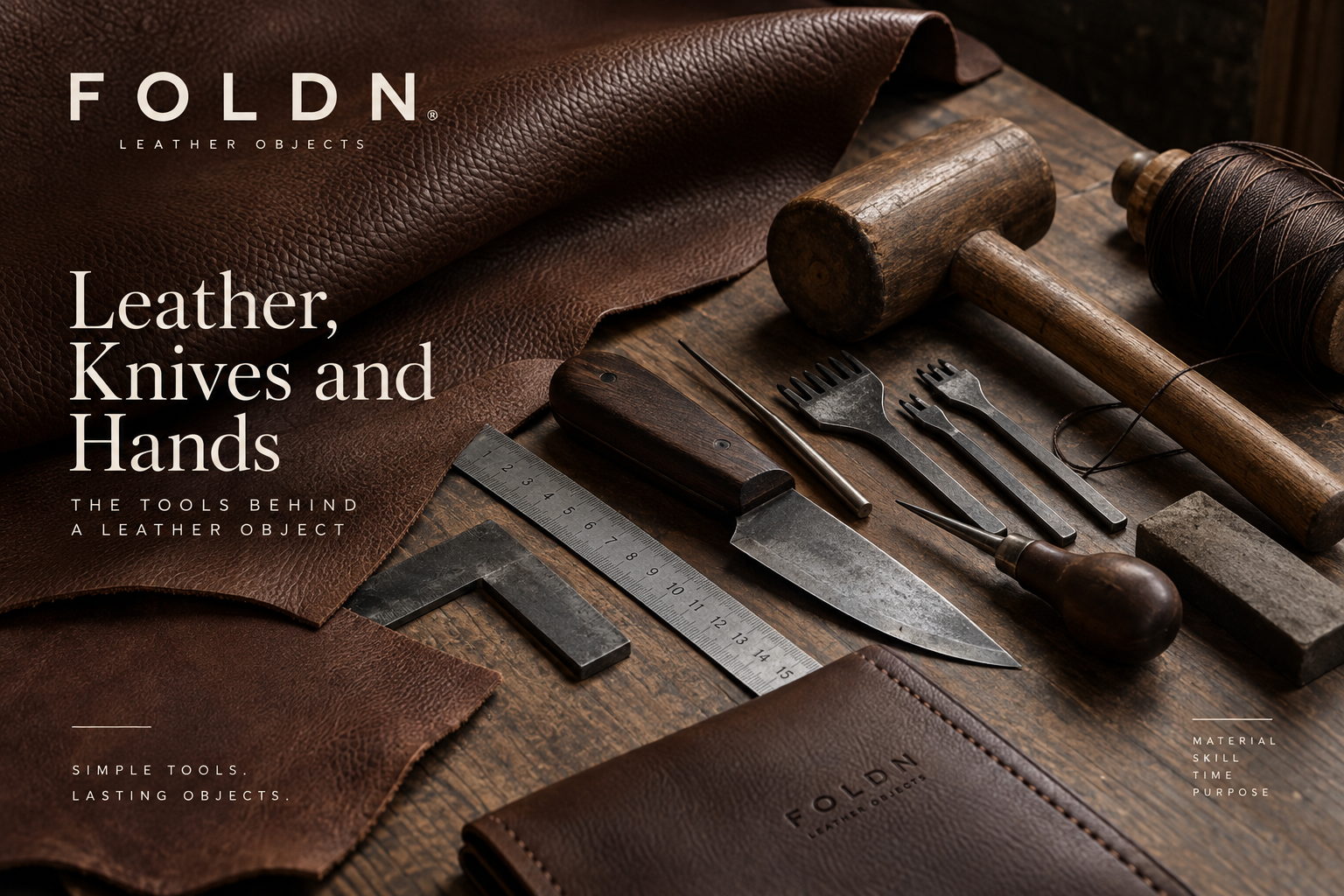
A leather workshop does not need to be filled with machines.
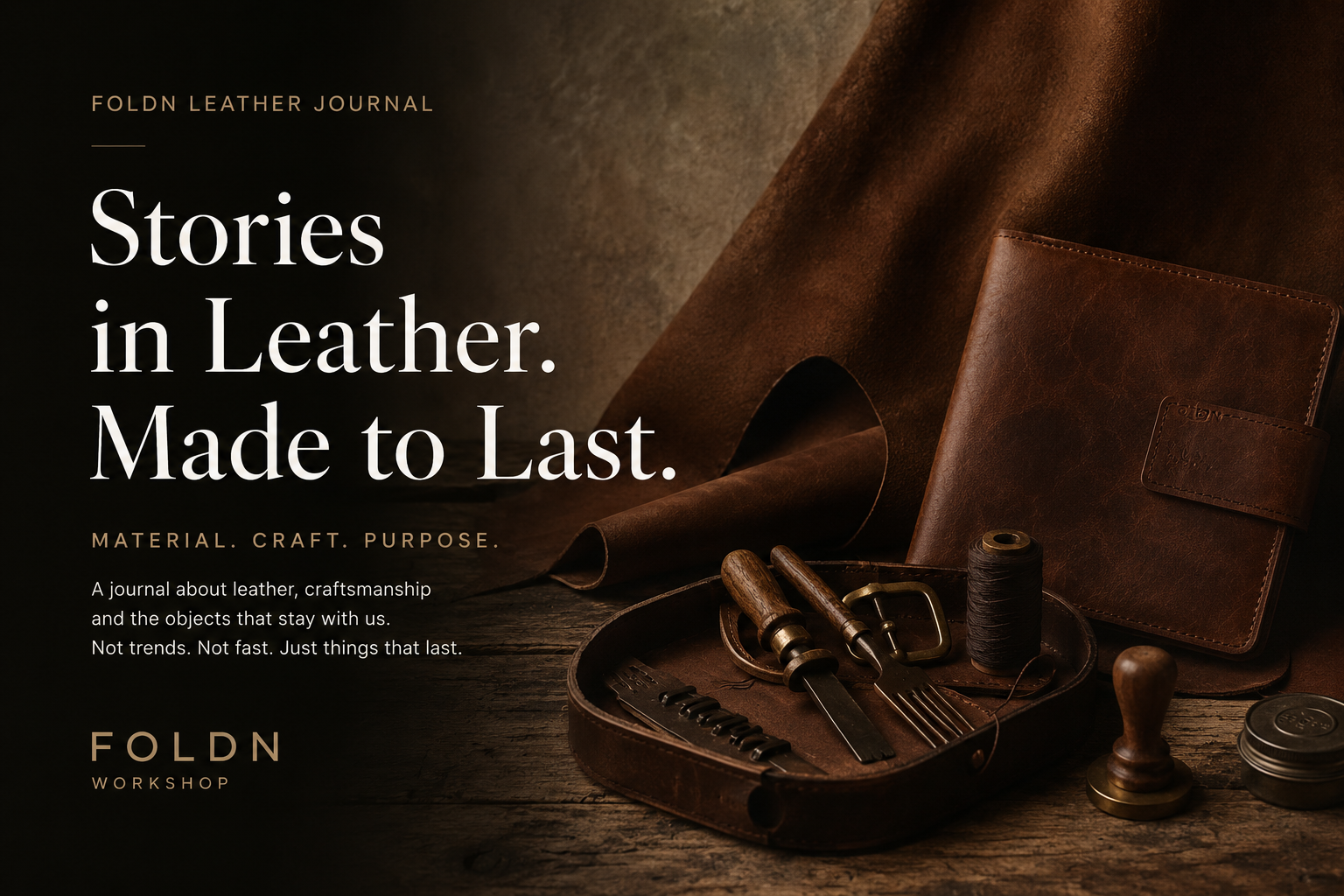
Some of the most useful tools are remarkably simple: a sharp knife, a steel ruler, an awl, a set of punches, a hammer, needles and thread.
That is more or less where the relationship between the maker and the material begins.
Leather does not need to be persuaded into becoming something. It needs to be understood. The tools simply allow the maker to make precise decisions.
The knife
The knife is perhaps the most important tool in a leather workshop.
Cutting leather is not about forcing a blade through the material. It is about control. A sharp blade should move cleanly, following the line without tearing or dragging the leather.
The better the blade, the less pressure is required.
For a handmade object, this matters. Every cut becomes part of the final object. A small deviation at the beginning can become a visible problem several steps later.
That is why sharpening the knife is not an insignificant preparation before work.
It is part of the work itself.
The ruler and the square
Leatherworking contains very little magic.
There is measurement.
A straight line.
A right angle.
A repeated distance.
A symmetrical shape.
A good steel ruler and a reliable square can therefore be just as important as an expensive specialist tool.
When working with leather, precision is not necessarily about making everything complicated. Quite often it means simply measuring twice and cutting once.
The awl
The awl is an old and almost primitive-looking tool.
It is also incredibly useful.
It can mark a position, open a small hole, guide a stitch or help reach a place where a larger tool cannot.
There is something satisfying about working with an awl. There is no motor, no noise and no speed.
Just the hand, the tool and the material.
Punches
Punches are used to create clean, controlled holes in leather.
They can be used for stitching, fastening and construction, depending on the design of the object.
A good punch should cut rather than crush the leather. The difference may seem small, but it becomes obvious when the finished piece is examined closely.
The spacing of the holes matters too. Stitching is not only structural. It becomes part of the visual language of the object.
The mallet
A punch needs something to drive it through the leather.
That is where the mallet comes in.
It may be one of the simplest tools in the workshop, but the way it is used requires some attention. The goal is not brute force. The goal is a controlled strike.
Too much force can damage the leather, the cutting edge of the punch or the working surface underneath.
Good craftsmanship often means knowing when not to use more force.
Needles and thread
Hand stitching slows everything down.
That is precisely why it is valuable.
A sewing machine can produce hundreds of stitches in the time it takes to make a small number by hand. But a handmade stitch carries something different: the rhythm of the person who made it.
The choice of thread matters. Its thickness, construction and colour influence both the strength and appearance of the finished object.
A stitch should do its job without becoming decoration for decoration’s sake.
When the construction is right, the stitching feels natural.
Edge tools and sandpaper
The edge of a leather piece is often overlooked.
It shouldn’t be.
The edge is one of the first things the hand encounters when touching an object. It can be sharp, rough, polished, rounded or deliberately left natural.
Different projects call for different approaches.
An edge tool can remove excess material. Sandpaper can refine the surface. Further finishing can produce a smooth, almost polished edge.
But there is no universal rule that every piece of leather must have a perfectly polished edge.
Sometimes the natural character of the material is exactly what should remain visible.
Adhesive
Glue is another useful workshop tool, but it should never be asked to do the work of good construction.
It can hold pieces in position, make assembly easier and prevent materials from shifting during stitching or cutting.
But the strength of a handmade object should come from its design and construction.
The adhesive is there to help.
Not to hide mistakes.
The workshop does not need everything
There is an endless market for leatherworking tools.
Special knives.
Special rulers.
Special punches.
Special machines.
Special presses.
Some of them are genuinely useful.
But collecting tools and making good objects are two different things.
A person can own an entire workshop and still produce poorly made objects.
Another maker can work with a handful of simple tools and produce something that will be used for years.
The difference is not the size of the toolbox.
It is the relationship between the maker, the material and the object.
Tools are only tools
At FOLDN, we are interested in simple objects made with attention.
That means understanding the leather before cutting it, choosing the construction before assembling it and accepting that handmade work will always carry traces of the human hand.
The tools make precision possible.
They do not provide the idea.
They do not make the decisions.
And they certainly do not make the object by themselves.
A good tool simply disappears into the process.
What remains is the leather, the construction — and the hands that made it.
FOLDN — Leather Objects, made by hand.